Showing posts with label Chapter 6. Show all posts

Friday, November 20, 2009

6.1 Continuation : Plasmids

Deffinitions:

See page 285 of textbook
  • Plasmid - Small circular pieces of DNA that can exit and enter bacterial cells
  • Plasmid Mapping - Process to determine where certain recognition sites are located and the number of recognition sites within the plasmid
  • Copy Number - Number of copies of a particular plasmid found in a bacteria cell
  • Multiple-Cloning Site - Region in plasmid that has been engineered to contain recognition sites of a number of restriction nucleases (restriction enzymes)
    -This means the plasmid was given specific nitrogen bases (in palindromic sequence, see last note, to allow enzymes to cut sequence at this point)


The Plasmid:
  • Plasmids are small double stranded circular DNA molecules that exist within many bacteria.


  • They range in size from 1000 - 200 000 base pairs.


  • A plasmid can have foreign genes inserted into its structure which will then be read by the bacteria, and replicated.


  • Plasmids are beneficial to the bacteria because they may contain genes that will help the bacteria to survive. For example, a resistance to heavy metals such as lead or mercury may be kept within a plasmid.

On the above plasmid there are 7 different recognition sites.

for a plasmid with only two recognition sites, the following choices can be made:

  1. Use one type of restriction enzyme to cut plasmid at one location(EcoRI for exapmple)
  2. Use a differnt restriction enzyme to cut plasmid at a different location (Hind III for example)
  3. Use both restriction enzymes to cut plasmid at both recognition sites simutaneously
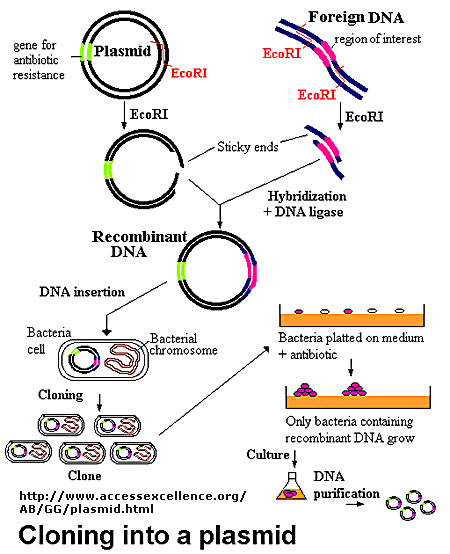


  • When a plasmid is cut, a new gene is inserted into the solution containing the plasmid. The plasmid base pairs and the sticky ends of the inserted gene will anneal and link together creating a new plasmid with the gene located within this new plasmid.

Thursday, November 19, 2009

6.1 Biotechnological Tools and Techniques

Definitions:

  • Recombinant DNA - Fragments of DNA composed of sequences originating from at least two different sources. Ex- Genetically Modified Organisms contain recombinant DNA to alter the characteristics of the organism.
  • Restriction Endonucleases (Enzymes) - Enzymes that are able to cleave double stranded DNA into fragments at specific sequences. These are restriction enzymes, act as scissors to remove a specific section of DNA to insert a new strand.
  • Recognition Site - Specific sequence of double stranded DNA (a palindromic sequence, spells same thing written both ways ... racecar) consisting of 4 - 8 nucleotides that a restriction enzyme recognizes.
  • Sticky Ends - Fragments of DNA with short single overhangs caused by being cut by a restriction enzyme
  • Blunt Ends - Fragments of DNA that are fully base paired but have be cut by a restriction enzyme.


DNA:

  • Prokaryote:
  • Eukaryote:


  • Recombinant:

  • A restriction enzyme cuts the DNA molecule at a specific palindromic sequence. For example, EcoRI is the restriction enzyme for: GAATTC
    CTTAAG

  • Vectors - Deliver DNA to a specific type of cell.

  • If the target cell was a bacteria call, a bacteriophage would be used to insert DNA into the cell.


  • Once a new DNA has been inserted along with the appropriate Restriction Enzyme, the old DNA will be replaced with the new and DNA ligase will attatch the new strand of DNA into correct position.


-6.1-3 from the handout section should be moved to your notes. The title is "Constructing a Plasmid Map". There is no due date yet.


-Brandon